The expansion of renewable energies in Germany is accelerating and with it comes a safety problem that many project managers underestimate. Solar parks combine everything that attracts thieves: high-quality materials on huge areas, remote locations away from populated areas and hardly any supervision outside working hours.
The scale of the problem is illustrated by current cases. In May 2026, perpetrators stole copper cables worth at least 160,000 euros from a solar park near Güstrow. The theft was not noticed until the next morning, when the operators noticed a drop in performance. Just a few weeks earlier, unknown persons stole kilometers of copper cable from a solar park in the Enzkreis district – total damage: around 300,000 euros. And in Alsenz in the Donnersberg district, organized groups struck several times in early 2026.
These individual cases are not exceptions. In 2021, the damage caused by solar system theft in Brandenburg alone amounted to 1.8 million euros. The actual figures are likely to be much higher, as many cases are not recorded as photovoltaic theft in the national crime statistics.
Why solar parks are particularly vulnerable
Solar park construction sites differ fundamentally from traditional building construction sites. It is precisely these differences that make them so attractive to thieves:

Remote locations without infrastructure
Solar parks are deliberately built far away from residential areas, on agricultural land, converted land or along highways. Neighbors who might notice something are missing.
Long construction times with changing personnel
Solar park projects run for months. Subcontractors and changing crew sizes make access monitoring more difficult. Who is known on the construction site and who is not can hardly be controlled without clear processes.
Organized perpetrators, professional approach
The groups of criminals work in teams, striking at night and transporting the stolen goods in vans and even large trucks. In many cases, there are several hours between the crime and discovery – more than enough time to remove large quantities of material.
Simple fences offer no real protection
According to the Saxony State Office of Criminal Investigation, simple wire mesh or wild fences, such as those that typically surround solar parks, are virtually no obstacle for organized criminals.
Enormous material values on an open surface
Copper cables, inverters, modules and substructures are often stored unsecured on the site during the construction phase. Allianz Versicherung warns that entire pallets of modules and inverters regularly disappear from solar park construction sites.
The true cost of theft
Material loss is often just the tip of the iceberg. For project managers and investors, the indirect consequences are often more serious:
A stolen cable package worth 50,000 euros can bring construction work to a standstill for several days. Repeat orders take weeks, subcontractors have to be re-coordinated and feed-in tariffs are postponed. The follow-up costs regularly exceed the actual theft damage many times over.
There are also insurance problems: many insurers now require proof of active safety measures before offering policies for solar park projects. If this evidence is missing, there is a risk of limited or delayed settlement in the event of a claim.
Last but not least, the reputation of the general contractor is at stake. Investors expect professional risk management – repeated security incidents jeopardize long-term business relationships.
Why classic safety concepts fail for solar parks
Stationary security on an area of 20, 30 or 50 hectares? Hardly economically feasible. A security service with regular patrols? The time gaps are easy for organized criminals to calculate. Stationary camera systems? They usually fail due to a lack of infrastructure – no conventional surveillance system works without electricity and internet.
The key question for project managers is therefore: How do I protect a large, remote area without an existing infrastructure reliably, around the clock and in an economically viable way?
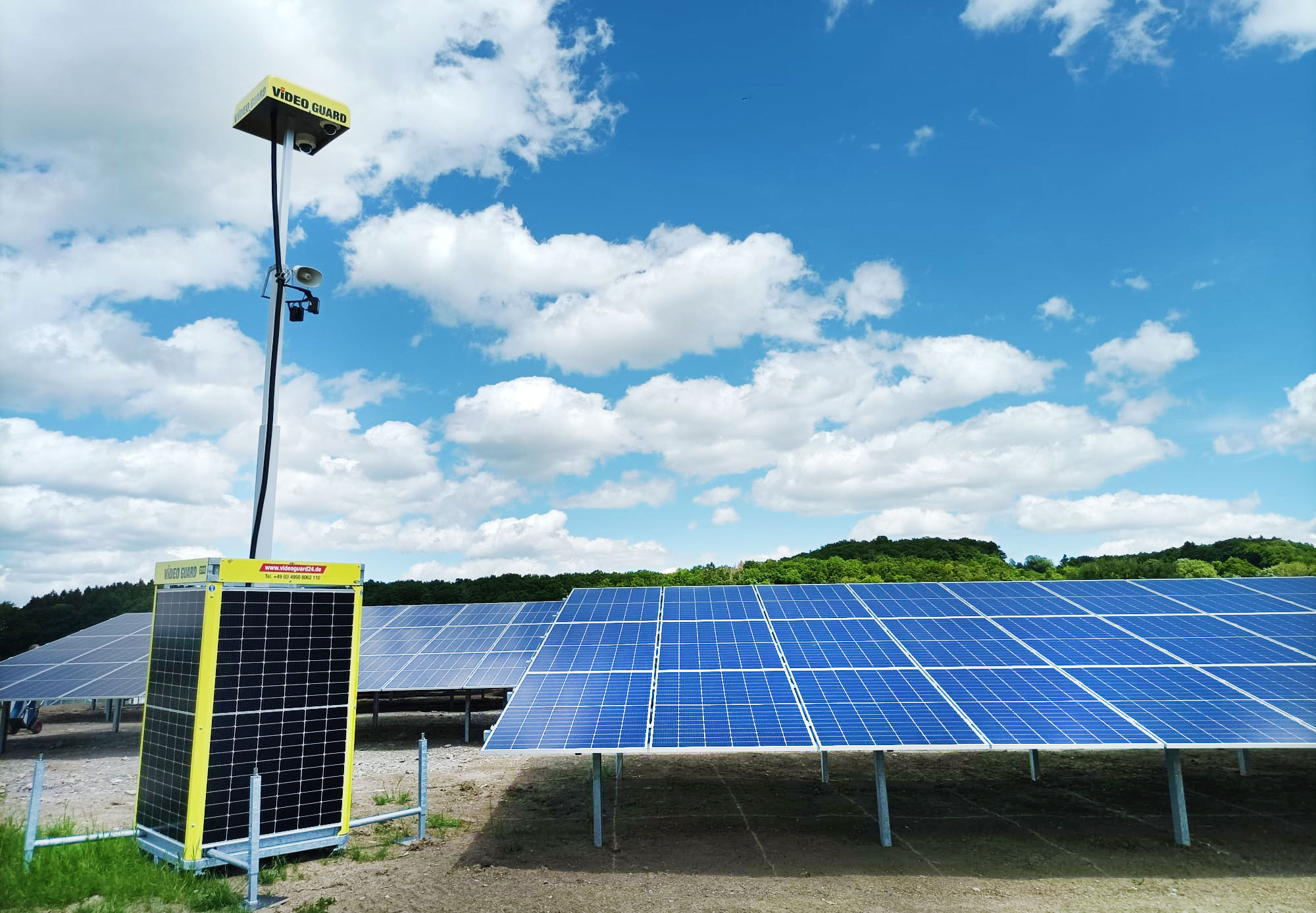
Self-sufficient camera towers: the solution for solar park projects
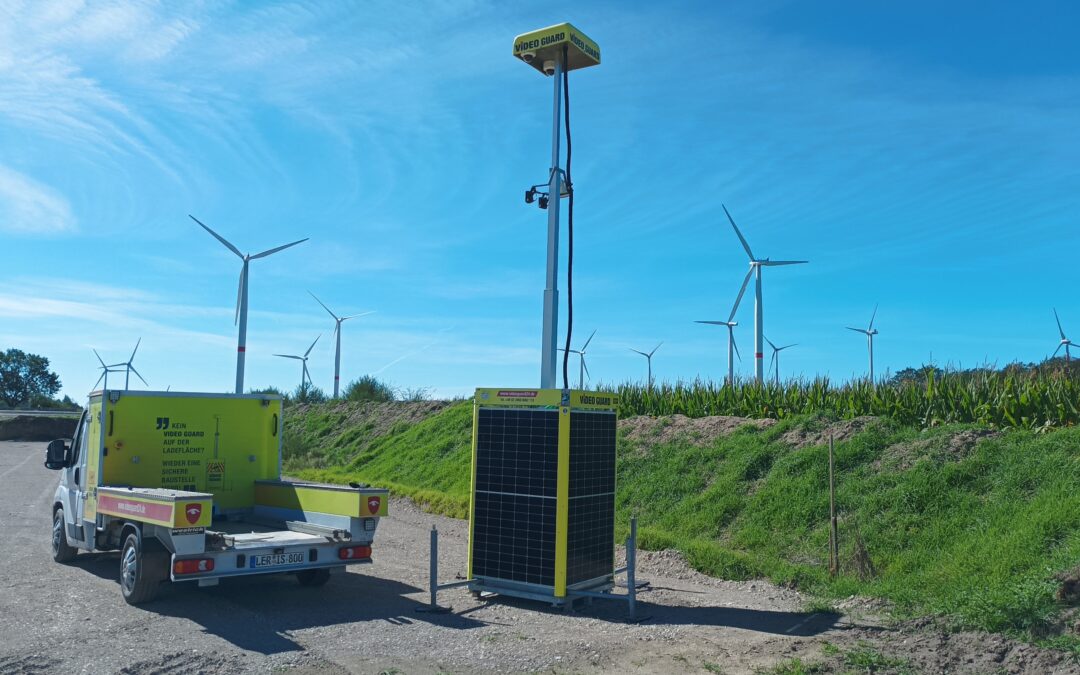
Mobile, self-sufficient video surveillance towers solve precisely this problem. Systems such as the VIDEO GUARD Solar are completely self-sufficient: photovoltaic modules, battery storage and fuel cells make them independent of mains power. Data is transmitted via LTE or 5G – an internet connection on site is not required.
In practice, this means that the towers are set up within a short space of time, cover large areas with high-resolution cameras and detect intruders using AI-supported analysis, even in complete darkness. False alarms caused by animals, wind or shadows are minimized by intelligent pre-filtering.
In the event of an alarm, a 24/7 manned control center in Germany is informed. Trained employees verify the incident in real time, address intruders directly via loudspeaker and alert the police if necessary – often before anything can be stolen.
Another advantage: the systems grow with the project. They secure materials and equipment during the construction phase and protect the operational system after completion. Flexible rental models mean that there are no long-term commitments, which is a decisive factor in temporary construction phases.
What project managers should do now
Anyone planning or already implementing a solar park project should consider the protection aspect from the outset. In our experience, three measures are particularly effective:
First: Carry out a risk analysis for the specific location. How remote is the area? What material values are stored there? Are there natural views or is the site completely concealed?
Secondly, opt for a monitoring solution that works without an existing infrastructure. Pay attention to GDPR compliance, German server locations and a control center – these points are also relevant from a regulatory perspective, especially for projects in the area of critical infrastructure.
Thirdly, start monitoring during the construction phase – not after completion. Experience has shown that the greatest risk of theft exists precisely when materials have been delivered but not yet installed.
Conclusion: protection is not an optional item
Solar park projects are investments worth millions. Leaving them unsecured is an economic risk that can be avoided. Mobile camera towers with a self-sufficient power supply and AI-supported detection are currently the only solution that works reliably in remote large areas without infrastructure.
Our experience shows that in most cases, the first prevented incident fully amortizes the investment in professional monitoring. Or to put it another way: The question is not whether solar park monitoring is worthwhile, but how quickly you can get started.