A security provider should not be chosen based on price alone, but rather on the actual level of protection it provides. Key factors include the control center’s response times, image quality, AI-powered pre-filtering, transparent pricing models, and verifiable compliance (GDPR, KRITIS, ISO 27001). A low daily rate is only cost-effective if, in the event of an emergency, the system detects the incident, someone responds, the video footage is admissible in court, and the insurance company accepts the proof of damage. If not, a single incident will more than offset the original savings. This article highlights five common cost pitfalls and provides a checklist for selecting a provider.
A Story from Everyday Sales Life
Some time ago, a long-standing customer of our sales team decided to switch to another security provider. The reason: a significantly lower asking price. Which is a reasonable decision. After all, companies have to keep costs in check, budgets are tight, and security often feels like insurance: important, but invisible.
A few weeks later, we received a call: “Could you please check the surveillance footage? A truck driver damaged the new gate.” Today, that customer is working with us again. Not because we’re the cheapest option. But because, when it really mattered, someone was available who took responsibility—no questions asked, no extra charges.
This experience is not an isolated case. It highlights what many decision-makers don’t realize until the first incident occurs: The price is on sale. That value is evident in everyday life.
The True Cost of Construction Site Theft
Before we look at the typical cost pitfalls, let’s take a quick look at the order of magnitude. According to estimates from the construction insurance industry, the annual losses due to theft from construction sites in Germany are in the high double-digit millions, and the trend is upward. In addition, there is a high number of unreported cases, as many incidents go unreported.
Even more critical than the mere value of the materials are the follow-up costs: According to expert estimates, construction delays, contractual penalties, replacement purchases, and insurance disputes often exceed the actual loss from theft many times over.
A real-world example from case law illustrates the scale of the problem: The Saarbrücken Higher Regional Court upheld a claim by a construction company from which materials for interior finishing work, valued at 98,000 euros, were stolen from a building shell that was nearly complete. The ruling: Under Section 644 of the German Civil Code (BGB), the contractor bears the risk prior to acceptance even if only the building owner had a key to the building. In our article “Who Is Liable for Theft on a Construction Site?”, you can read about what this means for your liability in concrete terms.
These figures are the benchmark against which you should compare security providers. After all, it’s not the daily price that determines whether your investment pays off, but whether the system prevents even a single costly incident.
The 5 Hidden Cost Pitfalls When Comparing Security Providers
Cost Trap 1: Long Response Times
An alarm is of little use if no one responds to it. In practice, there are enormous differences between providers:
- Poor detection performance despite high expectations
- Control centers abroad with language barriers and time delays
- Pure recording systems without active intervention
- Outsourcing control center services to subcontractors who lack a sufficient understanding of the situation
- No live address to the perpetrator, only a subsequent analysis
Our tip: Try testing your systems yourself at night to see if you are actually detected and addressed from a distance of 100 meters. And whether they can even hear the speech from 100 meters away. Only if you speak up promptly and loudly and clearly enough will the perpetrator stop what they are doing.
In our experience, the longer the reaction chain, the higher the risk of damage. With VIDEO GUARD, every alarm is routed to the company’s own 24/7 monitoring center in Germany, where trained specialists verify and assess alarms and, in an emergency, intervene directly via loudspeaker or alert the police. This real-time response is the key difference between a camera that records and a solution that protects
Cost Trap 2: Missing or Weak AI
This is where things get interesting from a technical standpoint. Many providers advertise high hit rates, but a hit rate on its own says little about practical effectiveness. The key factor is the interplay between the hit rate and the false alarm rate. Without intelligent pre-filtering, the following happens:
- Wind, animals, and shadows constantly trigger false alarms
- The control center is being flooded with reports of minor incidents
- The real incident gets lost amid the din of alarms
- Responses come too late when there are real threats
Modern systems therefore rely not only on edge computing but also on cloud-based AI filtering—that is, analysis performed directly on-site at the system and with much greater computing power in the cloud. More computing power leads to better results. The AI reliably distinguishes between people, animals, and vehicles, filters out irrelevant triggers, and adapts to changing conditions such as weather and lighting. The result: a high detection rate with a low false alarm rate—practical safety rather than just impressive statistics.
Cost Trap 3: Poor Image Quality
What good is a camera if, in the end, neither the face nor the license plate is recognizable? That is precisely when, in the event of a claim, what really matters is missing: admissible evidence. Insurers and government agencies need clear records. Otherwise, you’ll be left to cover the damage.
Classic Cost Traps:
- Low resolution (1 MP instead of 4 MP or more)
- Poor night vision without infrared or bispectral technology
- Limited effective range (often less than 50 meters)
A system that appears to be cost-effective becomes expensive as soon as the insurance company delays or denies a claim, citing a lack of evidence.
Cost Trap 5: Data Protection and Compliance Gaps
This cost trap is often underestimated and can end up being the most expensive one. According to the regulation, violations of the GDPR can result in fines of up to 4 percent of annual revenue. For projects involving critical infrastructure, the requirements of the KRITIS Framework Act have applied since 2025. Key factors to consider when comparing security providers:
- GDPR and KRITIS Compliance for Projects in Sensitive Areas
- Server location in Germany; no foreign cloud solutions with unclear data access
- NDAA-compliant technology (no components from manufacturers on the U.S. restricted list)
- ISO 27001 Certification for IT Security Framework
- No “backdoors”—that is, no hidden access points for third parties, such as those already documented in Chinese cameras manufactured by the state-owned company HikVision
Checklist: How to Compare Security Providers Properly
The next time you compare offers, go over these points:
Responsiveness
- In-house control center in Germany or outsourced?
- Response time in the event of an alarm (documented in seconds, not minutes)?
- Is it possible to address a suspect live over a loudspeaker?
- A direct line to the police and security services?
Technical Performance
- Camera resolution and range?
- Edge computing with AI-powered pre-filtering?
- Power supply with battery backup in case of a power outage, including Lighting?
Cost-Effectiveness & Contract
- A transparent fixed price with no hidden fees?
- Flexible term, adjustable based on construction progress?
- Are there clear guidelines in case of system failure or theft?
- Service, maintenance, and updates included?
Compliance & Data Protection
- GDPR-compliant and KRITIS-ready for sensitive projects?
- Server location: Germany?
- ISO 27001-certified company?
- NDAA-compliant technology?
Service & Trust
- German-language support with a dedicated contact person?
- Reliable references from your own industry?
- Any experiences with insurance companies and government agencies?
- Quick installation and removal?
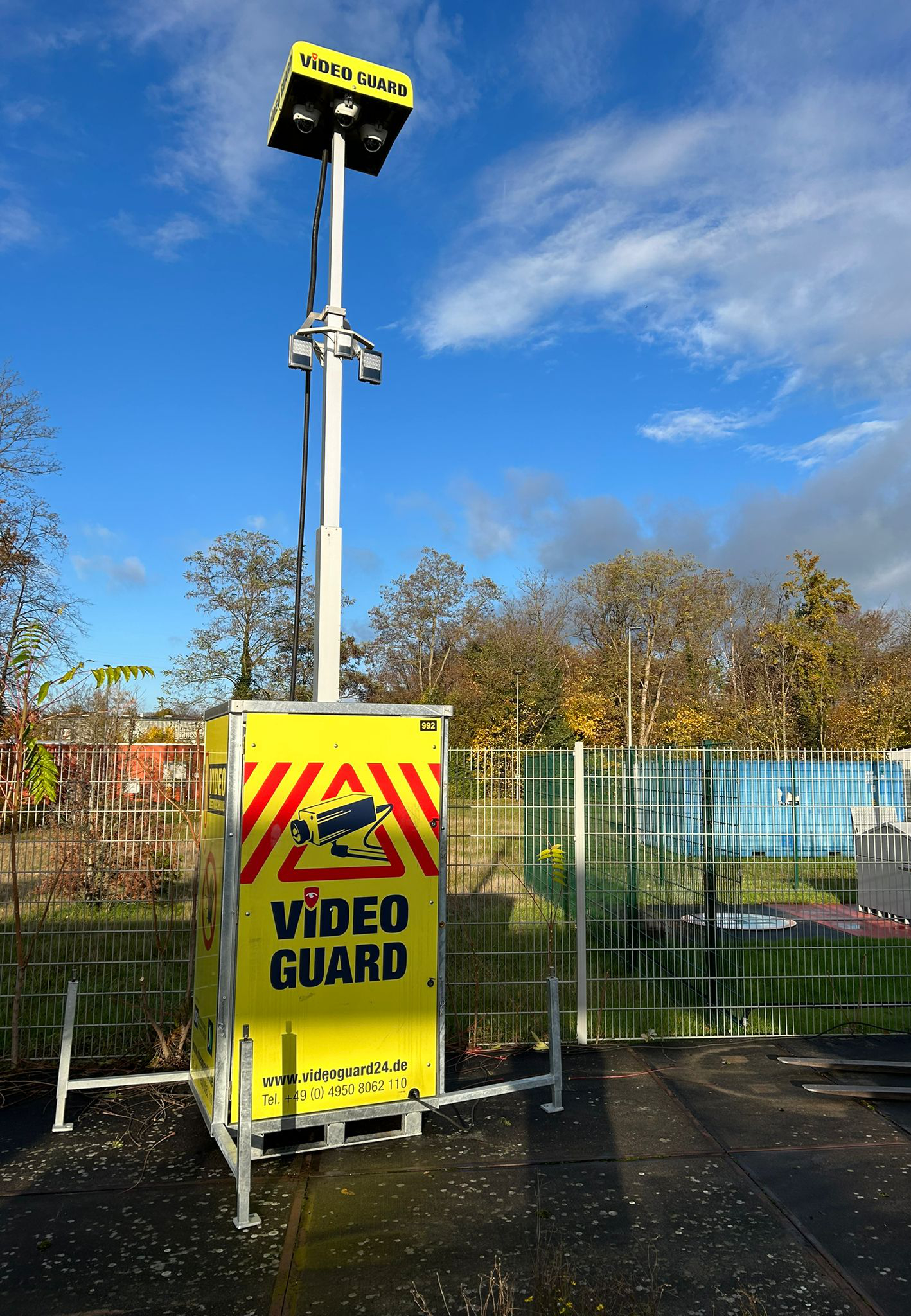
If you answer all the questions honestly, you’ll usually see within just a few minutes which provider truly offers security and which one is just presenting a sales pitch. For an initial overview of how a well-thought-out provider selection process works in practice, see “Your Journey with Us ” and our customer testimonials.
Frequently Asked Questions About Comparing Security Providers
Why is the lowest price often misleading when it comes to security providers?
Specifically, what should I look for when it comes to response time?
What does KRITIS compliance mean, and do I really need it?
How Can I Spot Hidden Costs in Lease Agreements?
Ask for a written breakdown of each item: service fees, surcharges for relocation, minimum contract terms, and liability provisions in the event of a defect. Reputable providers use transparent fixed-price models and clear contract terms.