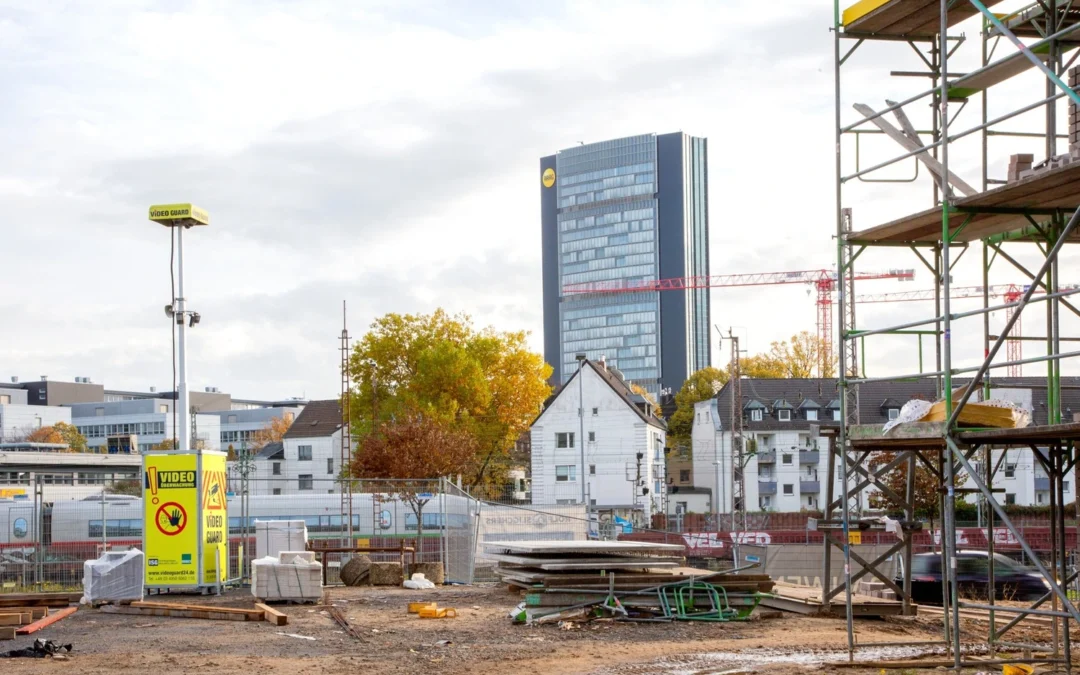
An eight-kilometer section of the project. A tunnel-boring train that advances 400 to 600 meters each week. A supply depot that moves with the group. And at night, they’re scattered all over an area that no one can reasonably fence off.
Anyone who works in civil engineering and road construction is familiar with this situation. And they’re also familiar with the reflexive response that follows: “It’s not worth it for just a few weeks.” In our experience, that’s exactly the most costly statement on a linear construction site. Because the risk doesn’t disappear just because the construction site is mobile—it simply spreads out.
Why Linear Construction Sites Have Their Own Risk Profile
Traditional building construction sites are defined by their boundaries: an enclosed area, designated access points, and a construction fence. Road construction sites are lines. And lines have properties that negate any point-based protection:
- No enclosed enclosure. A construction fence stretching over eight kilometers is neither economically feasible nor permissible under traffic regulations.
- Countless ways to access it. Dirt roads, private driveways, embankments, adjacent properties—a linear construction site is accessible from virtually every side.
- The value concentration moves along with it. Where the material storage area used to be yesterday, there is now a finished surface layer. After two weeks, a fixed camera location may end up monitoring nothing but asphalt.
- Very little social control. Driving through towns is still manageable. Open roads, bypasses, and highway sections are deserted at night.
- Rarely plugged in. There is generally no permanent power supply along the route.
What’s Left Behind at Construction Sites at Night
When it comes to theft at construction sites, most people think of the excavator first. In road construction, the range of damage is broader, and the minor issues are often the most painful.

Traffic Safety Technology
Guide beacons, warning lights, portable traffic signal systems, mobile traffic signs, and advance warning signs are left unprotected in public spaces. They disappear, get knocked over, or are destroyed. And this is where things get tricky: If the required signage is missing in the morning, traffic safety measures are no longer in compliance with regulations. You can’t just keep building—you have to restore it first.
Cables and Copper
In utility and sewer construction, cable reels are often left on the job site for days before they are pulled in. A case from Wiesbaden-Kostheim illustrates just how quickly this can lead to damage: Between Friday afternoon and Saturday morning in May 2026, about 200 meters of copper cable worth roughly 7,000 euros disappeared from a construction site there. Just one night, a weekend to prepare for the move.
Fuel and Machinery
For practical reasons, milling machines, rollers, excavators, and wheel loaders are left behind. Including the fuel, the batteries, and anything else that can be removed in a matter of minutes.
The economic consequences are now well documented. According to the Boels Rental Construction Index 2026, 43 percent of the construction companies surveyed reported thefts last year, 27 percent expect construction delays, and 15 percent have already experienced specific project delays due to the theft of materials, cables, or machinery (bau.bi). 55 percent of companies are now actively investing in security solutions.
The Fallacy: Focusing on a Single Point Instead of Following a Movement
The obvious solution would be to cover the entire construction site. In the case of a linear construction site, this is neither technically feasible nor necessary, since not every meter of the route is equally at risk.
In practice, the focus is on just a few key areas: the material storage area, the storage area for machinery, the construction site facilities area, and the main access road to the construction site. These points shift as construction progresses, but they are just points, not a line.
A viable plan for road construction sites therefore focuses on key areas that are moving forward, rather than on an area that doesn’t even exist. That is the real shift in perspective: You are not guarding a place; you are accompanying a movement.
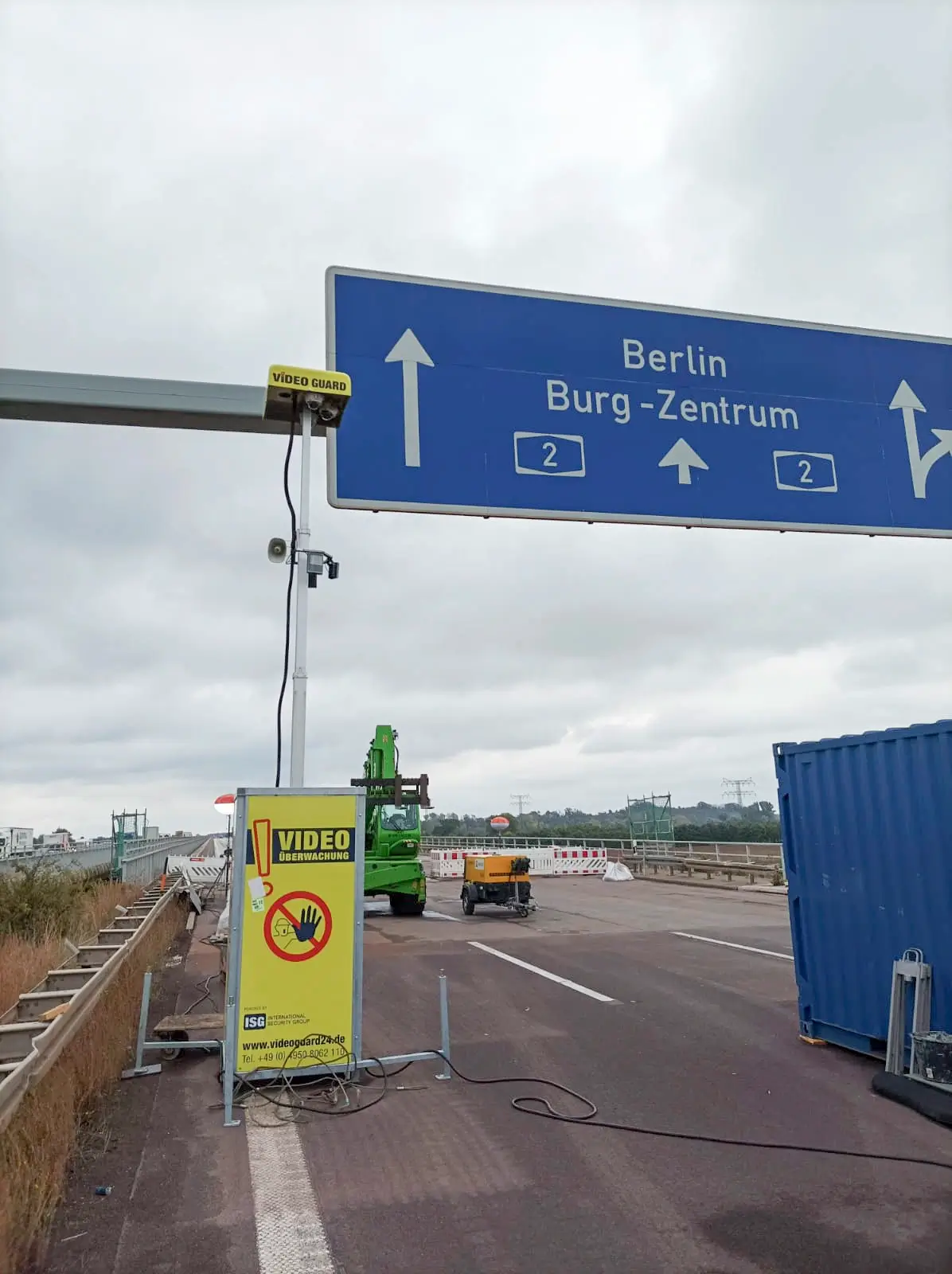
The tough practical question: How quickly can the move be completed?
This is where it is determined whether a safety plan will hold up in day-to-day construction work. Because if relocating a crane means changing its position, installing a new foundation, hiring an electrician, and going through a two-week registration process, then here’s what happens: The move gets postponed. Postponed again. And at some point, the system will be located two kilometers behind the current construction site and will no longer be guarding anything.
A relocation must be possible within hours, not days. In practical terms, this means:
- Transport using existing resources. A portable camera system should be able to move along with the vehicles on the construction site—without requiring special transportation.
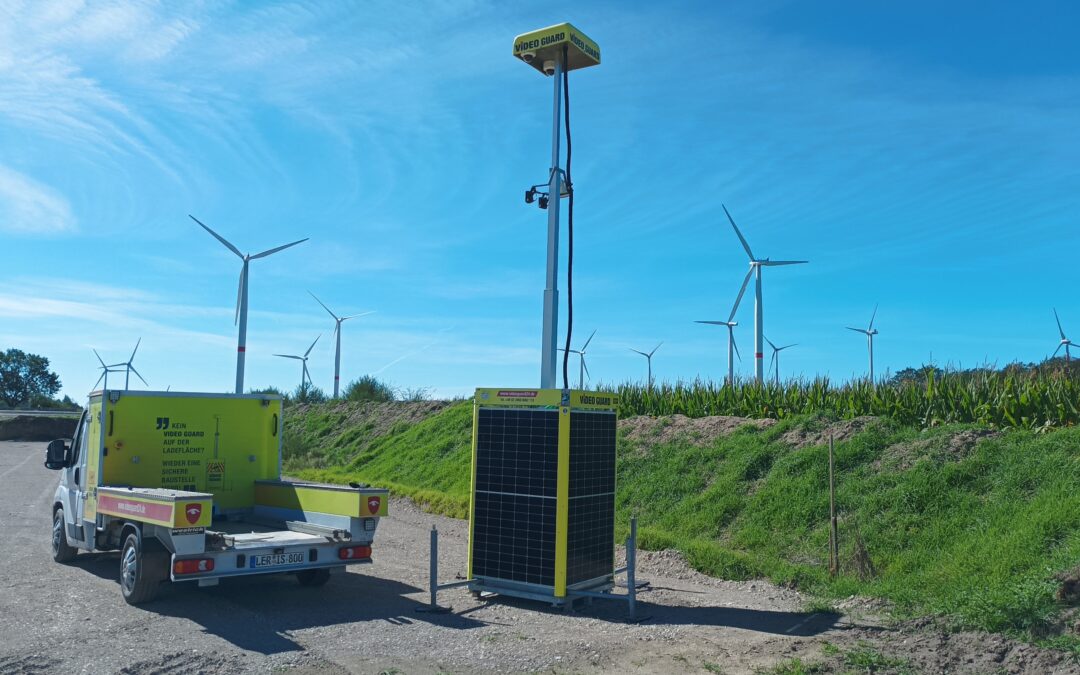
- Self-sufficient operation. Systems powered by solar energy and batteries allow for location selection independent of a grid connection. Our VIDEO GUARD SOLAR is designed specifically for such applications; the VIDEO GUARD FLEX really shines in situations where flexible installation and frequent relocation are required.
- No need to reconfigure the system every time you move. Detection areas, alarm zones, and exclusion zones must be able to be quickly adjusted at the new location—without requiring a service call.
- Clear lines of responsibility. The move is the service provider’s responsibility, not your team’s. Anything else wastes construction time in the wrong place.
A tried-and-true approach for long sections: alternating between two systems. One secures the active construction section, while the second is already being set up at the next focal point. This way, there are no gaps—and the move becomes a planned process rather than a disruption.
What a co-traveling system must be capable of
Conditions at a road construction site are harsher than at an enclosed construction site. Passing traffic, headlights, wildlife crossing the road, flapping tarps: All of these create movement in the image. A system that sounds an alarm every time will be ignored after the third night.
That is why it is less about the detection rate alone than about the combination of a high hit rate and a low false alarm rate. With VIDEO GUARD, AI-powered pre-filtering uses edge computing to distinguish between people, vehicles, and animals directly on-site. Only verified incidents are routed to our own 24/7 control center in Germany, where trained staff review the situation via live video feed, directly address intruders over a loudspeaker, and alert the police or security personnel as needed. This active risk prevention distinguishes surveillance from mere recording—everything is documented anyway, but only what someone interrupts in real time is prevented.
Crucial for public spaces: Adjacent properties, sidewalks, and roadways must not be included in the survey. Our systems use software to redact these areas in an audit-proof manner and operate in compliance with the GDPR, with servers located in Germany.