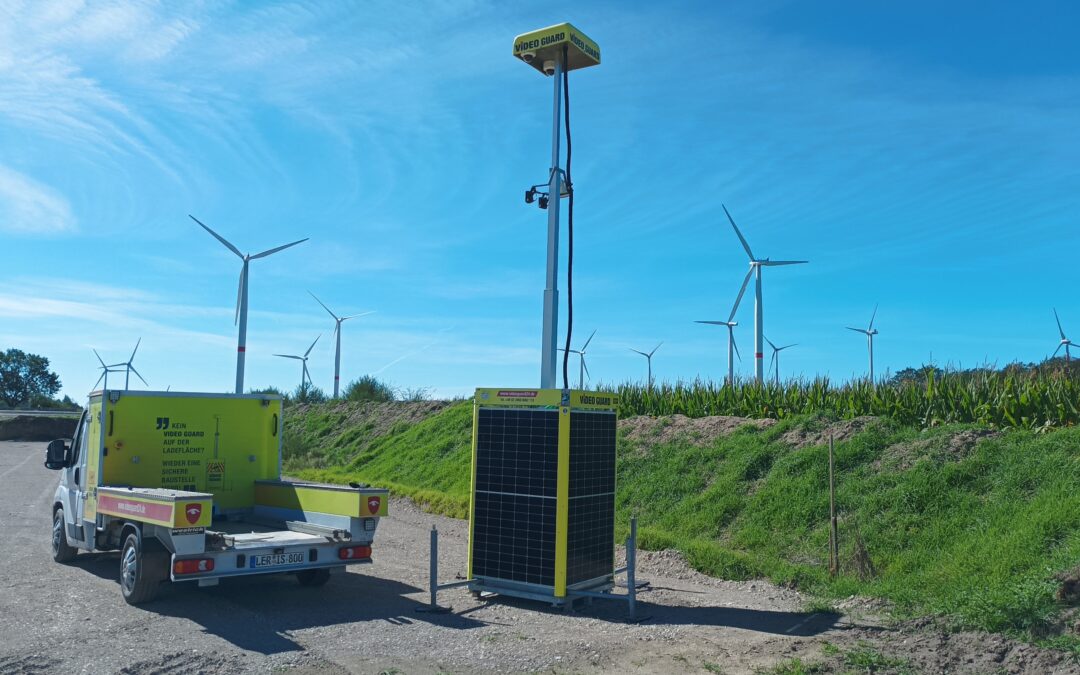
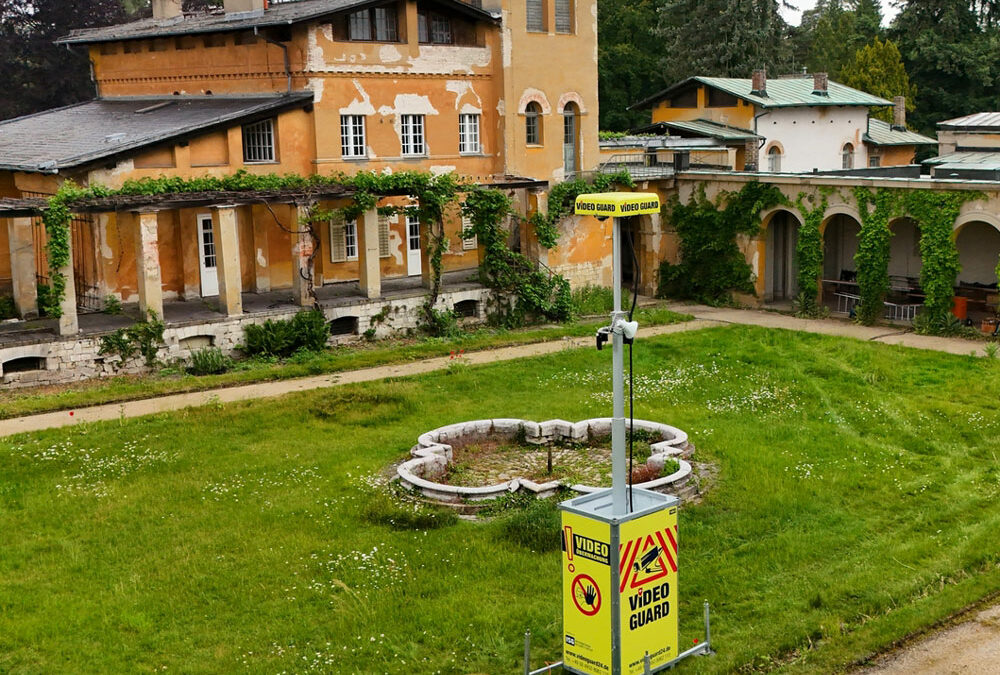
“Unfortunately, that’s not possible here—we don’t have any electricity out there.”
We hear this phrase regularly during counseling sessions. It can be found at the solar farm in the field, at the storage area on the outskirts of town, at the utility construction site (which has no temporary power supply), and at the municipal recycling center. And it almost always leads to the same decision: The area remains unsecured.
Yet that premise has long since become obsolete. Surveillance without a power connection is no longer an exception these days, but rather the norm. The real question is no longer “Is this even possible?” but rather “What does energy and transmission planning need to look like to ensure the system runs every day of the year—whether it’s sweltering hot or raining nonstop for a week?” This is exactly what this article is about.
Why remote areas, of all places, are particularly at risk
It’s an unfortunate correlation: the less accessible an area is, the more attractive it becomes to criminals. Where there is no electricity, there is usually no lighting, no neighbors within sight, and no short response times for the police.
Recent cases in the renewable energy sector illustrate just how high the damages can be. According to police, approximately 50 kilometers of cable were stolen from a fenced-in solar park in the Main-Tauber district—the material value alone was about 100,000 euros, and the repair costs were even higher. The Saxon State Criminal Police Office describes the perpetrators as operating as an organized group with a division of labor: They professionally dismantle modules, inverters, and cables, work at night, and transport the stolen goods away in vans or trucks.
A simple fence is largely ineffective against this method. What’s missing is the time factor: If you don’t notice that something has happened until the next morning, you haven’t prevented the incident—you’ve merely documented it.
How Self-Sufficient Surveillance Works Technically
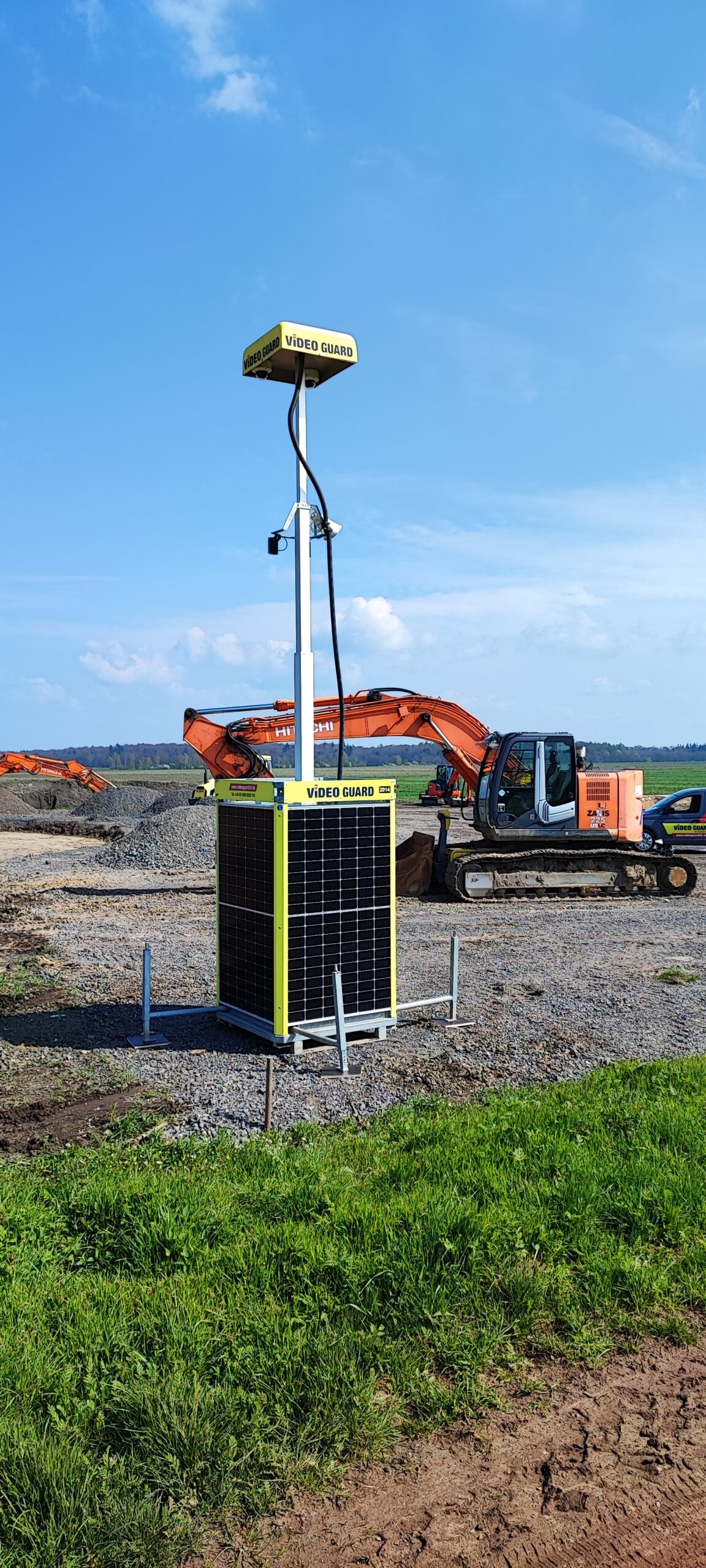
At its core, an off-grid video tower is a small, self-contained energy system. Three levels are interrelated in this process.
1. Photovoltaics as a Primary Source
Solar panels generate the electricity needed for ongoing operations. They generate energy even when the sky is overcast, since they utilize both direct and diffuse radiation. However, the yield fluctuates significantly throughout the year: About 70 percent of the annual yield is generated from April through September, while only about 30 percent is generated during the rest of the year.
Each season has its own effects: During peak-production months, high module temperatures reduce efficiency, and vegetation at the site can cast shadows that go unnoticed for weeks. During periods of low energy production, factors include a low angle of the sun, short days, and snow, leaves, or dust on the panels.
In terms of planning, this means that a system that runs smoothly on a sunny day is by no means guaranteed to be available year-round. A sound design always takes into account the worst-case scenario at the specific site—not the annual average.
2. Backup battery for balancing
The battery provides power through the night and for several consecutive days with little sunlight. It is the component that determines actual availability. In our experience, storage capacity is what sets professional systems apart from makeshift solutions: It’s not the camera resolution that brings a system to a standstill after a rainy week, but rather insufficient storage.
3. Fuel Cells as a Third Level of Safety
If there isn’t enough sunlight for several weeks, a methanol fuel cell takes over in our self-sufficient systems. It operates with low emissions and is quiet, making it suitable for use in nature reserves and near residential areas. The result is a three-tier redundancy system consisting of solar power, a fuel cell, and a battery: If one component fails, the other two keep the system running.
In practical terms, this means that the VIDEO GUARD SOLAR operates for months without any user intervention and without your team having to refill it. A diesel generator—which, in turn, must be refueled regularly and is itself a target for theft—is therefore unnecessary.
The Underestimated Second Factor: Data Transmission
Energy is only half the battle. A self-contained system is of little use if the alarm does not reach the control center. That is why the wireless connection is just as much a part of the planning process as the energy budget.
The good news: Network coverage is better than everyday experience might suggest. According to the Federal Network Agency’ s mobile network monitoring, approximately 97.8 percent of Germany’s territory is covered by at least one network operator offering 4G service. Only about 2 percent of the area is considered a “white spot” without broadband coverage.
For the remaining locations, there are solutions: multi-carrier SIM cards that automatically connect to the strongest available network, directional antennas, or raising the antenna higher on the mast. It is crucial that signal quality be measured at the specific location before installation, rather than being inferred from the coverage map.
Another factor that reduces the load on the network: The AI analysis runs directly at the tower (edge computing). So a video stream is not transmitted continuously, but only when a relevant event occurs. This reduces both bandwidth requirements and energy consumption.
Without an emergency response chain, self-sufficiency is ineffective
One point is regularly overlooked in the discussion about solar panels and battery capacity: A system that operates independently but only records data does not prevent theft—it merely documents it.
What happens after detection is therefore crucial. Every alarm is received at our own 24/7 control center in Germany. Trained staff monitor the incident in real time, address intruders directly over the loudspeaker, and alert the police or security personnel if necessary. In many cases, simply addressing the issue directly is enough to resolve it before any damage occurs.
Just as important: The system monitors itself. If the charge level drops unusually quickly or the wireless connection is lost, the system automatically alerts you.
Conclusion: The electrical outlet is no longer a disqualifying factor
If an area remains unsecured today, it is rarely due to technical limitations. Solar power, buffer batteries, fuel cells, and cellular communications are well-established technologies that have been proven in continuous operation.
What makes the difference is the planning behind it: an energy budget designed for the time of year when energy production is at its lowest, a reliable wireless connection, and an alert chain that actually triggers a response in an emergency. If you address these three points, you’ll enjoy the same level of security at an off-grid location as you would in the middle of the city—no matter the season.
Frequently Asked Questions
Does a solar-powered surveillance system work year-round?
Yes—provided the system is designed for that purpose. Since solar output can vary significantly from month to month, the system must be designed based on the lowest possible value, not the average. The buffer battery and fuel cell compensate for both extended periods of rain and months with low yields, ensuring uninterrupted operation throughout the year.
How long can a self-sufficient system operate without maintenance?
What happens if there is no cell service available at the location?
About 97.8 percent of Germany's territory has at least 4G coverage. In areas with poor coverage, multi-provider SIM cards, directional antennas, or raising the antenna can help. The signal quality should always be measured on site before installation.