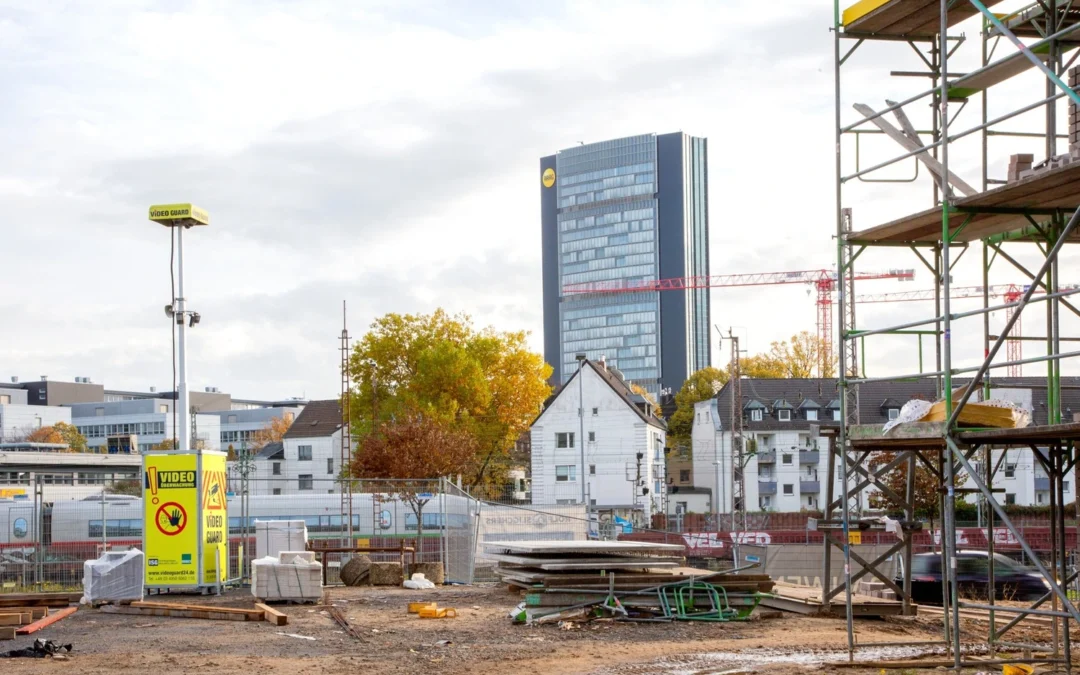
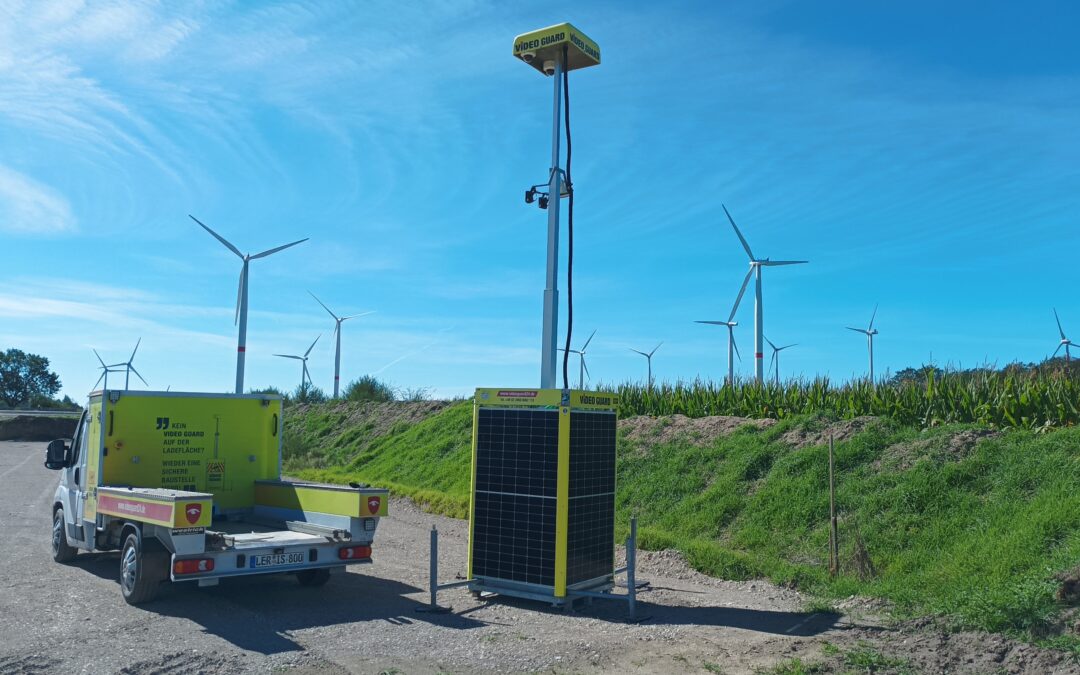
When people think of construction site surveillance, the first thing they usually see is the camera tower on the site. But what many people don’t know is that the actual safety work doesn’t take place on the construction site, but in the control center. Where incoming alarms are evaluated, decisions are made and measures are initiated. This is precisely where it is decided whether a security system really protects in an emergency or merely records.
We spoke to the team leader of our control center and asked: How does professional alarm handling work? What happens in the first few seconds after an alarm? And why is a dedicated control center in Germany so crucial for safety on construction sites?
What exactly does a control center for construction site monitoring do?
The task of a security control center sounds simple at first: receiving and evaluating alarms and initiating appropriate measures. In practice, however, this involves a complex interplay of technology and human experience.
“The control center bundles technical reports with human expertise and thus represents a comprehensive safety offering,” explains our control center manager. The combination is crucial. While AI-supported systems automatically detect and pre-filter movements, our experienced employees evaluate each alarm individually. You decide whether a voice announcement is triggered, a contact person is contacted or the police are informed directly.
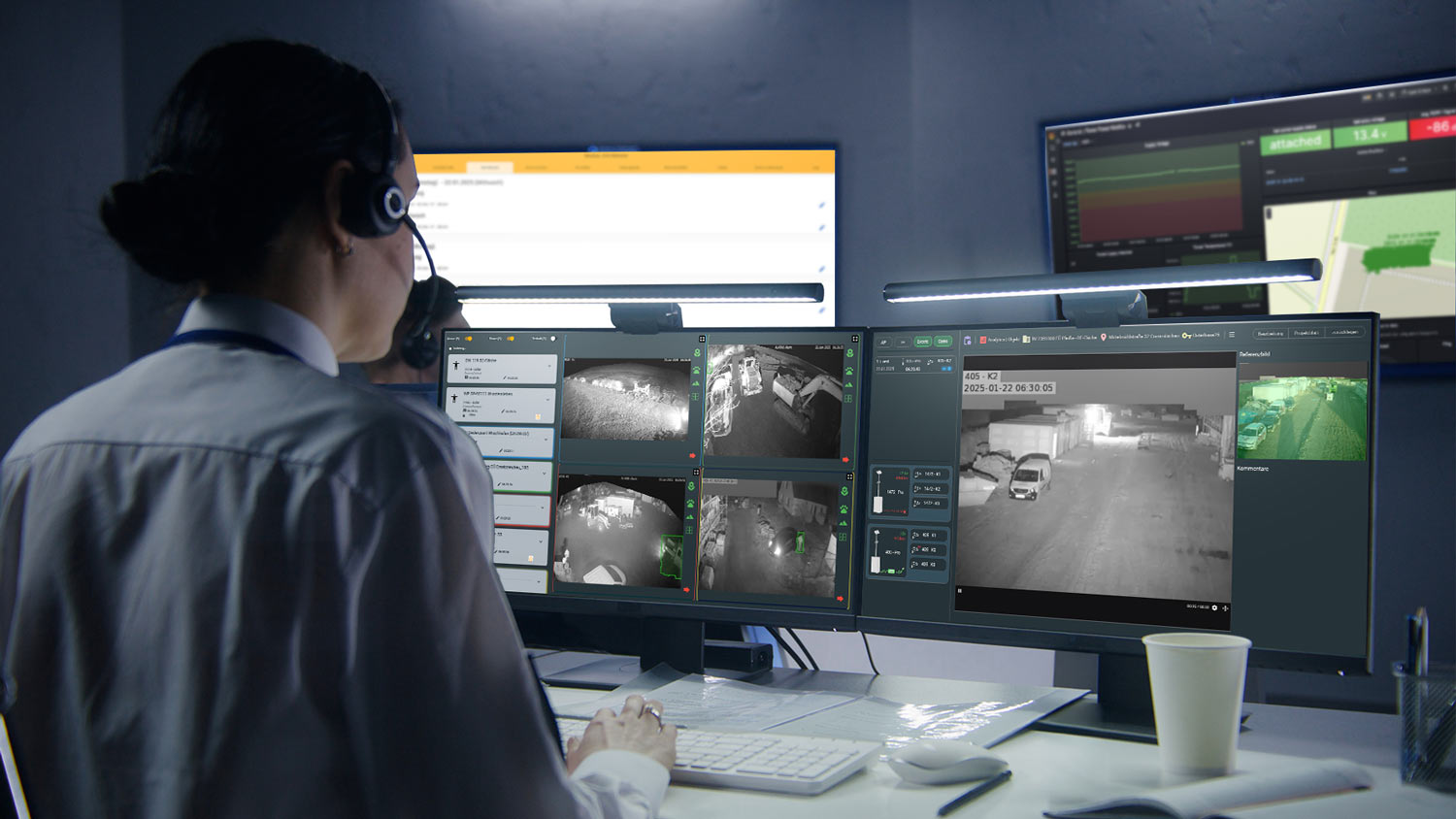
From alarm to response: how an operation works
As soon as a person enters the monitored area outside the set working hours, the system registers a movement. All alarms are first pre-filtered by a specialized cloud AI with the help of a lot of computing power, so that the control centre only receives safety-relevant messages. Irrelevant triggers such as animals, moving trees or light reflections, as they occur with conventional systems, are thus sorted out in advance.
The employees then select the alarm, view the video footage and make an individual decision on how to proceed. In the first few seconds, a check is carried out to determine whether they are authorized persons within the so-called waiting time – a 15-minute buffer zone before and after regular working hours. During this time window, the control center independently assesses whether the behavior of the person on site is suspicious.
“A quick call to the contact person often clarifies whether the workers are early or late,” says our control center manager Sven, describing the process. This differentiated approach prevents unnecessary police operations without jeopardizing safety.
In the case of visible crimes, however, the police are informed within the first few minutes. At the same time, voice announcements can be activated via the loudspeakers of the surveillance systems – a method that has proven to be extremely effective in practice.
Why addressing offenders directly is so effective
The ability to address intruders directly via loudspeaker is one of the features that distinguishes an active surveillance system from conventional cameras or dummies. The control center has various voice announcements that are used depending on the situation.
“Experience has shown that people who are not legally in a monitored area run away after an announcement,” reports Sven. The combination of visible camera technology, immediate response and the knowledge that a control center is watching live creates a deterrent effect that purely passive systems cannot offer.
When seconds make the difference
Construction site thefts can be carried out within a few minutes. That’s why every second counts – when triggering the voice announcement, calling the police or coordinating with the customer. Current figures show that this issue is highly relevant for the industry: According to the Boels Rental Construction Index 2026, 43 percent of the construction companies surveyed were affected by theft in the past year, while 15 percent already report specific project delays due to stolen materials.
Our control center manager Sven Friebel gives a concrete example from practice: “We were able to detect sabotage reports within a few minutes and thus prevent cable thefts, among other things.” In another case, perpetrators who had already committed several thefts before the monitoring system was set up were caught by the police thanks to the timely alerting of the control center. This resulted in a court case.
Such results are only possible if there are people behind the technology who act quickly, calmly and according to clear guidelines – even at night and in stressful situations.
What the control center means for the customer in everyday life
A professional control center offers considerable relief for site managers who often manage several projects at the same time. As soon as the working time ends, the project is automatically activated. At night, the control center decides independently on necessary measures without having to wake the customer for every event.
In addition, the control center performs numerous service tasks that are often underestimated in everyday life: If a video tower is disconnected from the power supply, the control center automatically informs the customer by e-mail and telephone. Alarm logs with the measures taken are automatically provided by email or via the dedicated myVideoGuard app. Each device is provided with a unique number that can be used to identify projects immediately.
An individual code word system provides additional protection. Authorized site managers can store a personal code word for their projects. This code word does not pass on any information to third parties.
The app as a supplement to the control center
Customers can use the Video Guard app to view and adjust working times and reference images at any time – around the clock, without telephone announcements. If contact persons go on vacation, for example, the call chain can be changed directly via the app. Changes made by the control center at the customer’s request can also be checked and tracked immediately.
This transparency creates trust and gives site managers the security of being able to maintain an overview of their projects at all times, even from a distance.
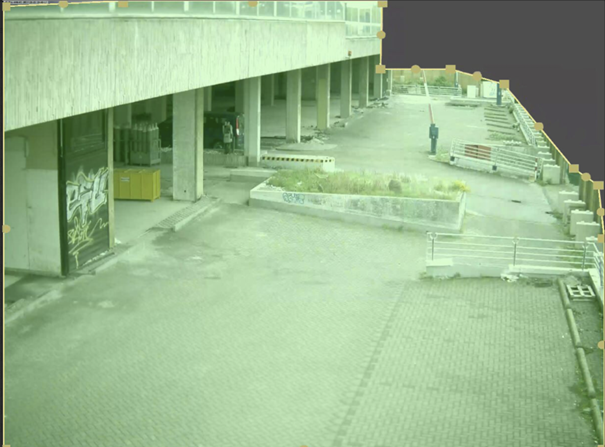
What many people don’t know about control center work
A common misconception: the control center sits in front of large screens and constantly monitors live images from all locations. The reality is quite different. “We monitor over 3,000 towers, but we don’t watch all the live images all the time,” Sven Friebel explains. Instead, the system works on an event-based basis. This means that the corresponding video material is only called up and evaluated when relevant alarms occur.
In addition to handling alarms, numerous other tasks are part of the control center’s daily routine: customer phone calls, e-mail communication, service calls and the direct forwarding of technical problems to the technical team. If a tower is moved without prior notification, the control center proactively reports that the monitoring area is no longer up-to-date.
Documentation and preservation of evidence
Careful documentation of every incident is an essential part of control center work and a decisive advantage for customers. Alarm logs not only provide information about measures taken, but also serve as proof when video files are overwritten after a certain period of time.
If requested in good time, the technical team will provide video material for police investigations in order to support prosecution. And complete documentation is also often of great value for insurance claims.
What makes having your own control center in Germany so valuable
Having our own control center in Germany means: German-language communication, short response times, GDPR-compliant data processing and German server locations. Questions about projects and alarms can be answered quickly and easily without language barriers or detours via international call centers.
Häufige Fragen zur Leitstelle in der Baustellenüberwachung
Was passiert, wenn nachts ein Alarm ausgelöst wird?
Die Leitstelle bewertet jeden Alarm individuell anhand des Videomaterials. Bei verdächtigem Verhalten werden Sprachdurchsagen ausgelöst und bei Bedarf sofort die Polizei verständigt. Berechtigte Personen werden über eine Karenzzeit und Rückrufe beim Ansprechpartner identifiziert.
Ist die Leitstelle auch außerhalb der Geschäftszeiten erreichbar?
Ja. Die Leitstelle ist 24 Stunden am Tag, 7 Tage die Woche besetzt – einschließlich Feiertagen und Wochenenden. Kunden können zudem über die App jederzeit Scharf- und Unscharfzeiten und Einstellungen anpassen.
Werden Videodaten für die Polizei bereitgestellt?
Ja. Bei rechtzeitiger Anfrage stellt das Technik-Team Videomaterial für polizeiliche Ermittlungen zur Verfügung, um die Strafverfolgung zu unterstützen.
Wie werden Fehlalarme vermieden?
Alle Alarme durchlaufen zunächst eine KI-gestützte Vorfilterung, die irrelevante Auslöser wie Tiere, Reflektionen oder Naturereigniss herausfiltert. Zusätzlich bewerten erfahrene Mitarbeitende jeden verbleibenden Alarm manuell, bevor Maßnahmen eingeleitet werden.
Welche Vorteile hat eine Leitstelle in Deutschland?
Deutschsprachiger Kontakt, schnelle Reaktionszeiten, DSGVO-konforme Datenverarbeitung und deutsche Serverstandorte. Das ist besonders bei Projekten im Bereich kritischer Infrastrukturen relevant, wo das KRITIS-Dachgesetz strenge Anforderungen an den physischen Schutz stellt.